The names of certain cities stick to the tongue
like a loogie on a brick wall in early August. Medellín is one of them. Though
not quite world-famous, it still lingers for some reason: is it because of Dan
Rather, the history channel or PBS? You know it’s a bad place – beautiful, hot
and dangerous – but you can’t remember why.
The city’s two most famous sons are Fernando
Botero and Pablo Escobar: as one ridiculed the country’s ruling classes, the
other hunted them down. In what many consider Colombia’s most
conservative city, that is saying quite a lot.
As many of you have no doubt heard, Medellín was
the world’s most violent city 20 years ago. In 1991, its murder rate was 381
per 100,000 inhabitants – more than twenty-five times the murder rate of
Chicago in 2013, the deadliest American city that year. In 2013, however, the
Urban Land Institute voted Medellín the world’s most innovative city – just above New York and Tel Aviv. Last
month, it hosted the UN Habitat’s 7th Annual World Urban Forum.
Clichés and attention-grabbing, international competitions aside, they did choose
the right town.
______________________________________
Medellín is also famous for being the heart of
Colombian industry. Well before Bogotá became more than a backward bureaucratic
outpost high on the Andean plain, Medellín was the national center of banking,
commerce, coffee trading and textile manufacturing. As the relative power of
the caffeinated bean declined in the latter half of the 20th century,
the city lost some of its economic muscle, but remained the headquarters of the
all-powerful National Association of Colombian Enterprises (ANDI), a union
representing the interests of the country’s most powerful industrial firms.
Then as now, socialism for the rich and capitalism for the poor is alive and
well in Colombia’s most dynamic city.
Flying into the city is a strange sensation.
Though 8 hours by bus, the 400km from Bogotá take scarcely 25 minutes by plane.
After hundreds of miles of rugged, uninhabited mountains interspersed by
snaking rivers, the plane lowers its flight over a vivid green patchwork of
hillside country manors sown into the earth like juxtaposing puzzle pieces. The
domineering capital of a rich and fertile region, Medellín has scrills.
But as a Midwestern sage once said: with great
privilege comes great responsibility. Despite the city’s rightly commended
efforts to enfranchise much of its poor, the gap between the city’s
light-skinned lords and its darker-skinned peons looms large. The booming
hillside slums, however, are far from the saddest – or scariest – part of town.
______________________________________
Halfway into the hour-long bus-ride from the
airport to the city, the sky morphs into a dark and ominous purple. Since entering
any “world” city for the first time is a memorable, enduring and eye-opening
experience, the threat of a nasty storm only added to its allure. As the black
clouds gathered their thoughts, we pulled over at the intersection of a busy
thoroughfare to let our first passenger out. While the guitar-doting man in the
Marlins hat descended, I made eye contact with another gentleman standing
nearby. The latter was around 30, clutching a little Chihuahua in one arm and
smoking a cigarette with the other. Just beneath his baggy athletic shorts was
a large tattoo of a woman in suggestive attire (I even put on my glasses to
verify it wasn’t a lizard or a dinosaur).
As we entered the city center, the skies came
crashing down like a glass ceiling at Smith College. As sheets of rain fell
upon merchants and schoolchildren scrambling for shelter, a new element emerged
to the surface. Like a flood, they arose from every direction: fiends, cluckers,
glue- and crackheads of every extraction – as far as the eye could see. Though
it only lasted a moment – 3-4 blocks at most – it felt like the opening scene
of a dystopian English film (Children of Men? 28 Days Later?). I saw more
shoeless, disheveled fiends in three minutes in Medellín than I have seen in the
past five years alone.
Nor were they simply homeless: they were young,
skinny, strung-out, dirty and desperate; clutching little glass capsules and
darting between cars – an army of indigents reclaiming the streets at the only
moment possible. Here in the center of the city, under a dark sheet of rain,
our bus careening past cathedrals and Botero sculptures, there were more
vulnerable, crazed and cracked-out young people than any parent, municipality
or country might care to admit.
Five minutes later, we crossed a bridge and left
the center for the leafier part of town we were staying. As if magically, the
avenues widened, the trees grew tall and the buildings all turned to brick.
Once again we were surrounded by well-heeled Colombo-Spaniards, Toyota
4-runners and Japanese take-out joints. We had crossed the threshold.
It rained without stop for the next 12 hours.
______________________________________
To awake in Medellín is to awake in a paradise lost.
It is 68 degrees and sunny, and a slight breeze has managed to penetrate the bamboo
and flower-studded courtyard. The window perpetually ajar, you awake to the sound
of birds chirping. If it weren’t me arising to these circumstances, I would
condemn them as decadent, bourgeois and cliché. But it was, so I won’t. If good
Americans die in Paris, the middling ones at least go to Medellín.
We have breakfast and walk to the metro station. There
is a café or a pool-hall on every corner of the tree-lined boulevard en route.
Men lounge in white pants and adolescent boys ride shirtless by on their
friends’ pegs. Women with gigantic bundas saunter on down the sidewalk like
they’re selling caramel apples at the Alabama State Fair.
Unlike many parts of Bogotá, the street that leads to
the metro, 70th Avenue, is neither boogie and benumbed nor prolie
and depressing. Many neighborhoods have achieved that cool, calm and collected
self-confidence of a people mostly happy in their ways. Every establishment has
outdoor seating – even the barber shops. Life is conducted in the open air
rather than the under horrible white hospital lights most Colombians install in
their homes and places of work. Perhaps it is the weather: as anyone who has
been to the beach can attest, vitamin D is a powerfully democratizing force.
And when it’s a little too warm to stay inside, it matters far less where you
live.
But it’s not just the weather. Residents of Medellín
are on the whole warmer, fresher, friendlier and more curious than the
counterparts in the capital. A 7-year old girl dressed up as a police officer
came up to us on the metro to ask us where we were from; she then inquired
about which part of the United States Switzerland was in. The rest of the
passengers in the train car, mostly young mothers, smiled and turned to listen
as we told our little volunteer representative of the Law what we were up to in
her neck of the woods.
______________________________________
Medellín installed an above-ground metro in 1995 in
the aftermath of some of the worst violence to befall any city in Latin American
history. In no time it became the pride of the city, if not the country; and
with good reason. It is clean, attractive, fast, effective, inexpensive and,
once again, above ground. From its spacious, air-conditioned cars the passenger
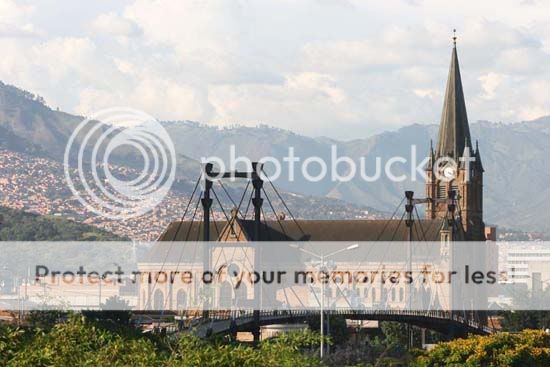
has a 360-degree vista of the city in every direction. Downtown, a series of daring new skyscrapers and 19th century churches
dot the immediate cityscape. Further afield, relentless orange-brick slums creep
up the sides of the mountain ranges that flank the city to the east and west. They
resemble an avalanche in reverse, only trickling off at the top.
With the exception of tall and balding men, most
things are prettier from above. Even the rotting carcass of Calcutta is mysterious
and stunning from the sky. Viewed from the elevated train, Medellín is a city of
myth and wonder; of Spanish tiles and lush green gardens; colorful, bustling
markets and towering steeples. It is hard not to see why paisas, as people from the region are
known, take such immaculately curated pride in their little corner of the
world.
We get off near the end of the line to transfer to the
cable-car that slices up into the mountain through Santo Domingo, one of the
city’s largest – and previously one of the continent’s most dangerous – slums. As
recently as 2003, a year before it was opened, there was a 5pm nightly curfew.
After sundown, the streets were policed by urban militias.
Today, Santo Domingo is (literally) one of the city’s most
colorful neighborhoods (pictures on book of face forthcoming). The cable-car
stops two times as it ascends the hillside slum before reaching the Biblioteca España, a daring,
award-winning new library near the top of the mountain. The black, boulder-like
structures, which not only blend into the mountainous landscape but boldly defy
it, were specifically placed in on the outskirts of one of the neighborhood’s
roughest patches. It is also 5-6 blocks from the immaculate and modern
cable-car – so even for the intrepid tourist, there is no escaping some
“minimal” contact with the community.
Inside, a group of adolescent boys giggle, stare and
follow us up three flights of stairs before working up the courage to ask for
an interview for a school project. They are each wear baseball caps with silly
headings like “RIOT” and “I LOVE RASBERRY PASTRIES” etched across the front.
None of them have creased the bill of their hats; instead of wearing it, they simply place it on top
of their head, rather like the old Bolivian
women in their miniature English bowlers.
We sit down at a table in the library and the boys ask
3-4 questions. “What ees your name, sur?” and “How do you like May-day-jeen?” Before
long, however, comes the almost inevitable “What do you thinks of May-day-jeen’s
womans?” Though two of them are quite tall, they cannot be older than 14 or 15.
I wanted to ask if they or their teacher had come up with the questions, but
they didn’t seem to understand anything I said outside their prescribed
questions.
______________________________________
Leaving the library, two 5 or 6 year-olds approach us.
Maybe they were 7: in my mind, anyone under three and a half feet isn’t beyond
kindergarten, but I could be wrong. They offer to give us a historical tour of
the neighborhood: adorable but commanding, we had to accept.
The little rascals didn’t have much to say: “cable-car
this, crime that; city government this, people living here and there that.”
Though the one doing the talking didn’t utter a complete sentence or a single
fact, he spoke with remarkable grace, confidence and charm: a born salesman
(politician, pundit or PR-man), he could have sold water to a drowning man.
This, they say, is another legendary paisa capacity: though inhabitants of a
deep valley, surrounded by two mountain ranges and largely cut off from the
world – and even most of their country – they are remarkably talented
merchants, businessmen and spin-doctors.
______________________________________
Apart from being friendly, warm, gregarious, sharp and
shrewd, paisas are simply gangster. Though the thuggish affliction often
translates into higher crime, addiction and pregnancy rates – all of which are
extremely prevalent in Medellín – it means they also live more fun, exciting
and (momentarily) meaningful lives. The city of “eternal spring”, it is always
early June in Medellin: high 60s in the early morning and low 80s in the
afternoon. At least in the hood, no male under 18 wears a shirt. Instead, they
carve mullets and Mohawks into the back of their heads and spend the day
shooting pool, watching soccer and flying around on motorbikes. Poor and ostensibly
jobless, they have made permanent professions of what gap-year English lads can
only dream of doing on holiday in Cambodia for several months at a time.
Residents of the Santo Domingo slum also grow up far
earlier than most people on earth. After parting ways with our 5 year-old
historian, we decide to descend the hill by the winding, curving, cascading
series of steps that plunge from the top of the slum back down to the rest of the
city. With two exceptions (one: an adolescent throwing rocks at us and two, a
clucker coming up to me to declare that “he love
money”), it was surprisingly safe. In some of the most commendable urban planning
I have ever seen, there were soccer fields, piazzas and skate parks built
around each stop of the cable car.
Within these public spaces mingled every walk of life,
from young mothers to old
paisa men. The best, however, were the two 2-year-olds with buzz cuts and
overalls marching up the stairs – by themselves – as we went down. Less than
two feet tall, for all I know they were still shitting themselves; but that
wasn’t going to keep them from posting up in the piazza to peep game. Those who’ve
seen Dave Chappelle’s “Baby on the corner” skit have a rough estimate of what
the deal is. Across the way lingered a group of older kids, this time leaning
against the back of the bench. None of them could have been older than six. If
Allen Iverson was smoking blunts and drinking 40s at age eleven, kids in San
Domingo have the block on lock by seven.
______________________________________
Unfortunately, instant gratification usually has its
darker side – and the ability to live a thuggish, carefree existence is rarely
distributed equitably across gender: for every shirtless 11-year old boy on the
back of a motorbike in Medellín, there is a 12-year old girl doused in make-up,
a cutoff shirt far above the bellybutton, booty-pants and cheap stilettos. Throughout
the whole city, girls that couldn’t have been older than ten were not only
donning coochie-cutters and platform shoes – they were still clutching their
mothers’ hands as they did so. On the metro, girls as young as five were
wearing lip gloss.
Beyond the age of puberty, this was practically the
norm. For 5-6 years, young, poor and pretty women are ostensibly the talk of
the town. By the end of their teenage years, however, there was not a single
girl in Santo Domingo not toting
around one or two children – and sometimes three. And it wasn’t just in Santo
Domingo. Everywhere on the metro and all over downtown, mothers were extremely
young, and young children were extremely abundant. For better or worse,
Medellín must be one of the most fertile places on earth.
If only procreating were enough. Women in Medellín are
also famous for squeezing themselves into comically revealing attire: scarcely
a lady under 40 goes by that doesn’t
give you a very accurate idea of her exact physical dimensions. But it is not
just the balmy weather: the pressure to don makeup and cutoff blouses, painfully
tight jeans and heels is ubiquitous in both myth and reality. The side of every
other building downtown is draped with 30-feet ads for different no-name jean
companies: donning a denim cowboy hat, the women in the ads scarcely wear
anything else.
One cannot take public transport anywhere in Medellín without
being reminded every 30 seconds of exactly what Colombian advertizing agencies
and their clients think women should resemble: smiling, half-naked and pumped
full of silicon. From the persistently pervy stares they illicit, their men
seemed to agree.
______________________________________
Such is the paradox of Medellín that is hard to
describe. Warm, sunny, funky, fun and friendly, it is also deeply conservative,
if not reactionary, in its approach to gender and economics. Socially, however,
it is on the cutting edge: no city in North or South America has better parks,
squares, plazas, open spaces or public transport that I know of.
The Sunday we were there was also election-day, and public
transport was free. However crowded the metro, people still waited for others
to exit before boarding (something unheard of in Bogotá’s morally
disastrous Transmilenio) and meticulously gave up their seat whenever a
pregnant woman or elderly person boarded.
Everywhere we went – the botanical gardens, the Barefoot
Park (a zen-like park of sand and fountains for children to run around
barefoot and “feel their connection with the Earth”) or the typically-named Park
of Desires – there were throngs of people – couples, families and extended clans
alike – lounging, laughing, sipping fresh-squeezed lemonade and losing count of
how long they’d been there. It seemed the most harmonious, civically-minded and
family-oriented polity I’ve ever come across.
______________________________________
Yet as good privileged gringos, we were still obliged
to head south to finish our day in the posh area of El Poblado, where rich,
white and globalized Colombians mix almost exclusively with their European and American
expatriate counterparts. For better or worse, such neighborhoods are usually
the only place to find decent coffee or good books in Colombia, so with a mix of
guilt and guilty pleasure we hopped on the southbound metro.
Whatever their claims to driving the cultural life of
the capital, richer areas of Bogotá are as sterile as North
Carolina’s eugenics program of the 1960s. Paisas being known for their
notorious sense of humor, on the other hand, I was hoping Medellín’s boogified bits would be a livelier affair.
There was only one catch. Election-day in Colombia is
more than an opportunity to elect the most extremist of various right-wing
candidates: it is also a chance to sober up. Since no booze can be sold in the
24 hours prior to or during voting, many retreat from public places en masse.
Indeed, that Sunday in El Poblado was the embodiment of the ancient dilemma one
learns the hard way at some point in high school: “we’re best friends, but have
I ever met you sober? This might not work.”
It was mid-afternoon on a beautiful Sunday afternoon
and the neighborhood and its hundreds of bars and restaurants were completely empty.
Worse, these are outdoor establishments – and they were still open. There were
nothing but barren, empty tables as far as the eye could see. Nor were these bistros
along the side of the Luxembourg Gardens: they were empty Hooters, abandoned burrito
joints, endless barbecue cocktail bars and – wealthy, young Colombians’
all-time favorite – the ubiquitous, expensive and beautifully named
establishment, Buffalo Wings.
Whether or not they were deserted didn’t seem to
matter: each establishment was still blasting techno into the street on a
Sunday at 3pm. It looked, felt, seemed and smelled like an abandoned playground
for wealthy and deranged adults; some dystopian, tropical telenovela
where “the worst of Dayton Beach” meets “the worst of Dubai.” More so than in
Bogotá, rich, young and white residents of Medellín seem condemned to blindly imitating
the miserable, overpriced, cultural nightmare they imagine their American
counterparts to be living. As long as there’s booze involved, I guess it’s just
about tolerable.




No comments:
Post a Comment